I am constantly in the long term process of arranging how my notes on local history can be made coherent by devising what I call ‘storylines’.
One of the ways I work through this is to communicate with several small groups of individuals who have been able to provide feedback. But they can only take so much and so I often work alone until I have cracked how to group new information into new or established storylines.
Now that I am building up my confidence to communicate to a wider public, I would like to share a few notes which show the development of this process.
This work is also informed by two other highly distinct disciplines which I will draw on implicitly or otherwise, they are knowledge management and narratology. Although separate disciplines they share a vast overlap.
So I can proceed without feeling self-conscious about disrupting the flow of daily news, you can pick the notification icon for this topic which will start with Normal and select Muted.
Then this topic will not appear in the ‘Latest’ timeline.
To revert this, search for ‘storylines’ pick this topic and scroll to the notification button and select Normal.
And for those folks who are reading this (after that brief announcement) I thought I’d start with Leslie Howard.
This turned out to be unimaginably earth-shattering.
I have been working on this ‘storyline’ (last time I use quotation marks) on and off for more than a decade. It’s like everything about this man and his life has been a lightning rod, connecting to any and all sources of energy in striking distance. And I still haven’t scratched the surface.
Without any hyperbole I can say with absolute confidence that a man acting in all innocence who had lived in Sydenham is implicated in his plane being shot down, all because of Bletchley Park. I have located the documentation. Because everything I’ve researched is all out there I now have to live with the turmoil of chronic self-doubt because part of my brain says this is too good to be true. For this reason I have developed a small network of correspondents who have been helping me evaluate my findings.
I can’t go through their individual names for obvious reasons, but the least I can do is to thank the Friends of Albion Millennium Green, Forest Hill Society, Sydenham Society, the late Steve Grindlay and the late Mike Guilfoyle (of Brockley Cemetery) for tolerating and sometimes indulging my laser focus on connecting tiny details from obscure plots here and there and creating giant connect-the-dots style portraits.
Leslie Howard has also provided backstories for interpreting the significance of the Havelock dynasty, a mystery surrounding Mr Horniman’s second wife and an ambiguous but significant attestation about a central theme in my ongoing project called The Mystery of Forest Place.
Steve Grindlay wrote in 2009 about identifying a participant in Mass Observation who had been living on Kirkdale around the top of Thorpewood Avenue.
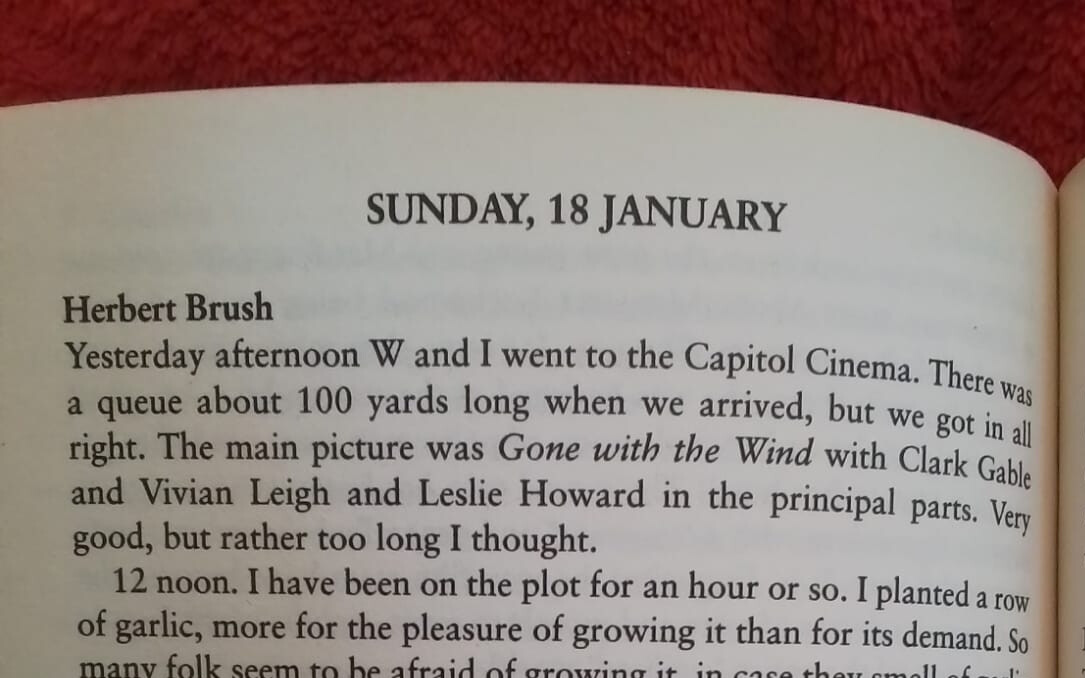
Upon delving deeper into the story many years later I was stunned to discover the aforementioned gentleman Herbert Brush had been to The Capitol to see Gone With the Wind. And suddenly it hit me that when Leslie Howard would have been pushed in his pram by the nanny (at their home in Westbourne Drive) up to London Road, he and his family members would pass the site of the large villas that would later become the plot where The Capitol was built.
Everything started to slide into place. I would eventually have the means to convert some seriously detailed pieces of history into easy-to-tell storylines which could be incorporated into local walks.
I was just going over the family tree of the Earls of Dartmouth as I do (periodically) to correlate historic dates in the development of their manors at each epoch when I saw the surname Nicoll and decided to check whether it was a distant cousin of one of my research subjects Margaret Nichol, which I am yet to resolve.
But instead I accidentally found that Margaret Nichol, a key individual in the provenance of The Chandos Portrait of Shakespeare, (accession number NPG 1 at the National Portrait Gallery) is the same name Nichol from which the legendary place name The Old Nichol is derived.
I had already been looking into Charles Canning Winmill who designed our Perry Vale fire station. Winmill was also extensively involved in the Boundary Estate.
I just thought someone out there (even if only 1 person) might be interested in my day to day research methodology.
The Chandos Portrait and the Chandos pub are indeed related, which is a strand in my project The Mystery of Forest Place.