It won’t be long before you all realise I am cooking up tens of projects and have been developing some quite extensively. The introduction of this new forum is like a dam bursting for me as I finally feel there is a safe space to start opening up about each one and how they will integrate as a whole.
I have been conceptualising several trails, three of which are quite substantially developed. These are:
All Beyond, a 5km circular trail to situate the history of Albion Millennium Green in the greater context of Sydenham Common.
The Quintessence, a short circular trail around a 5 sided shape which bounds the neighbourhood block immediately around Albion Millennium Green.
Perry Trail, from Mayow Park to The Capitol, taking in nature and history at different scales.
And now I am ready to start talking about Poetry Metres.
The name derives from the the idea of a ‘poetry mile’ which originally covered a distance from Walter de la Mare in Bovill Road to David Jones in Brockley and included Ernest Dowson in Brockley Cemetery and Saint Hilda the patron of Caedmon (the earliest English poet whose name is known).
But because Thomas Campbell had lived behind what is now Sydenham Station and because I had discovered TS Eliot had taught an evening class at Sydenham School, I thought lets take this all the way to where Robert Browning had lived near New Cross Gate Station.
So of course I had considered that I would call it something else beyond a mile. Then after thinking about miles and kilometres I realised metre is an axiomatic structure in poetry and the name Poetry Metres was born.
I didn’t think I was ready to write this all just yet, but it’s all clicking into place, so I’m going with the flow. The poetry trail is actually integrating whopping bits of history along the way that were so utterly epic in scope I never originally thought there would be an elegant solution how to solve this.
I will run some off the top of my head, roughly from south to north:
Crystal Palace is a name derived from a comment by Douglas Jerrold, however it does appear in Percy Shelley’s Prometheus Unbound Act IV, in line 101.
            From that deep abyss
            Of wonder and bliss,
      Whose caverns are crystal palaces;
            From those skyey towers
            Where Thought's crowned powers
      Sit watching your dance, ye happy Hours!
Westwood House, home of Lady Charlotte Campbell who discovered William Blake at a party most probably given by Caroline Lamb, and authored one of the first written encounters of meeting him, at which Thomas Lawrence the painter so beloved by the Mayow family was present. Charlotte was through the house of Argyll a distant cousin many times removed of Eleanor Marx. (Caroline Lamb was the first cousin of William Cavendish, Joseph Paxton’s friend, employer and mentor. Caroline Lamb’s lover Byron had schooled at Dr.Glennie’s Academy opposite Cox’s Walk.)
St. Mary’s Oratory where Father William Frederick Faber was the great-uncle of Geoffrey Faber, from Faber and Faber.
Thomas Campbell a ‘kinsman’ of Charlotte Campbell who lived overlooking the canal and the common. He was sent to London from Scotland with the financial support of Thomas Telford.
TS Eliot lectured at Sydenham School in an evening course, and was central to Faber and Faber.
Richard Jefferies, not a poet himself, but a scion of the Harrild clan whose followers then and later include renowned poets such as his biographer Edward Thomas who himself later inspired Robert Frost to write The Road Not Taken. A more recent follower is Robert Macfarlane.
Leslie Howard starred in Gone With the Wind, a line from an Ernest Dowson poem whose biographer is ‘our own’ Jad Adams.
Tudor Hall, a school opposite Christchurch which later moved to Burnt Norton, the place that inspired Eliot’s Four Quartets.
Walter de la Mare from Bovill Road had a son Richard de la Mare involved in Faber and Faber who played a crucial role in the career of artist and poet David Jones.
Leslie Paul, co-founder of The Woodcraft Folk and poet who had published a response to T.S. Eliot’s Four Quartets.
Spike Milligan who excelled in levity.
St.Hilda’s Church is a reminder of the patron of Caedmon and through Whitby Abbey — Dracula, whose own origin goes back to Lord Byron as Byron’s doctor Polidori wrote The Vampyre at Villa Diodati where Mary Shelley wrote Frankenstein. Polidori’s nephews the Rossetti brothers were instrumental in rescuing Blake’s works from obscurity. Our own (late) Gavin Stamp of Devonshire Road worshipped at St.Hilda’s and wrote about its architecture.
Forest Place somewhere about or opposite The Brockley Jack was a farmholding in the will of Brian Annesley (Lord of the Manor of Lee) who is noted by Shakespeare scholars as having an unusual connection to the play King Lear which coincidentally references Childe Roland.
Landholdings of Robert Nugent, 1st Earl Nugent a patron of Oliver Goldsmith.
Landholdings of Roger Manwood (commemorated by Manwood Road) a patron of Christopher Marlowe.
David Jones lived in Brockley and is buried in Brockley Cemetery as is Ernest Dowson.
Childe Roland to the Dark Tower Came is a poem by Robert Browning who had lived in a house approximately on the site of my alma mater Haberdashers’ School where there is now a plaque.
It is widely recognised by literary critics that T.S. Eliot’s The Waste Land (1922) was influenced by Robert Browning’s (1855) Childe Roland to the Dark Tower Came, and so the circle is completed.
While researching Forest Hill House School (FHHS) I found an archival note from the National Trust at Greenway in Devon.
It is a book of Virgil’s poetry awarded as a Latin prize to a scholar, Arthur Henry Hicks at FHHS.
His son was (Agatha Christie’s son-in-law) Anthony Arthur Hicks born in Bishopsthorpe Road Sydenham, the man who suggested to Agatha that she rename Three Blind Mice to The Mousetrap in reference to Hamlet.
I was also astonished and delighted to discover that apparently Spike Milligan had played a role in the campaign to save the conservatory from Coombe Cliff. It is now proudly one of the best additions to the grounds of the museum. My source is the article below, but I would like to find some further evidence for this as it marks a local poet so closely to the built environment.
I conceptualised such a ‘poetry trail’ not as an outcome of my local history research so much as more an attempt to explore how an activity (reading, writing and discovering poetry) can be made more meaningful when ‘situated’. In this sense I mean situated in the same way pilgrims might move through a landscape and stop at shrines, topographical views and hospitality stops to concentrate on their personal or shared experiences of focus (or meditation). The impetus comes from my reading of what logotherapy means to me.
This shifts the emphasis from what is knowable to what is meaningful.
The reason it is primarily focused around the original route of the canal (between Crystal Palace and New Cross) is because I had begun to think about a Croydon Canal Heritage Trail.
I will detail this separately at some point, hopefully in way that discussion about the canal can remain on its own dedicated topic so speculation about any possible heritage trail design can stand independently alone and the two do not become conflated.
But one overarching theme came to mind besides the purely historic interest alone. It was the idea of the canal as a slower way of life when we took time to go from here to there.
We must not romanticise the past (even though some poets have) by imagining that life was less hectic say before trains. Poorer people would have spent all day surviving, as in many ways they still do today albeit in perhaps different ways or circumstances.
But in recent times we have seen a reaction to the speed of life and it is called the slow movement and I was totally inspired by the thought of channelling that vibe along the historic route of the canal. And what symbolises a measured pace and patient reflection more than time to read and discover poetry, even small amounts.
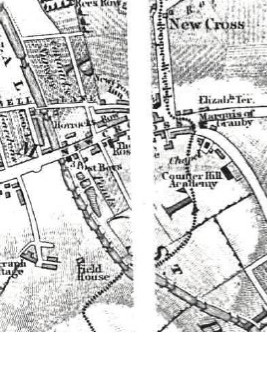
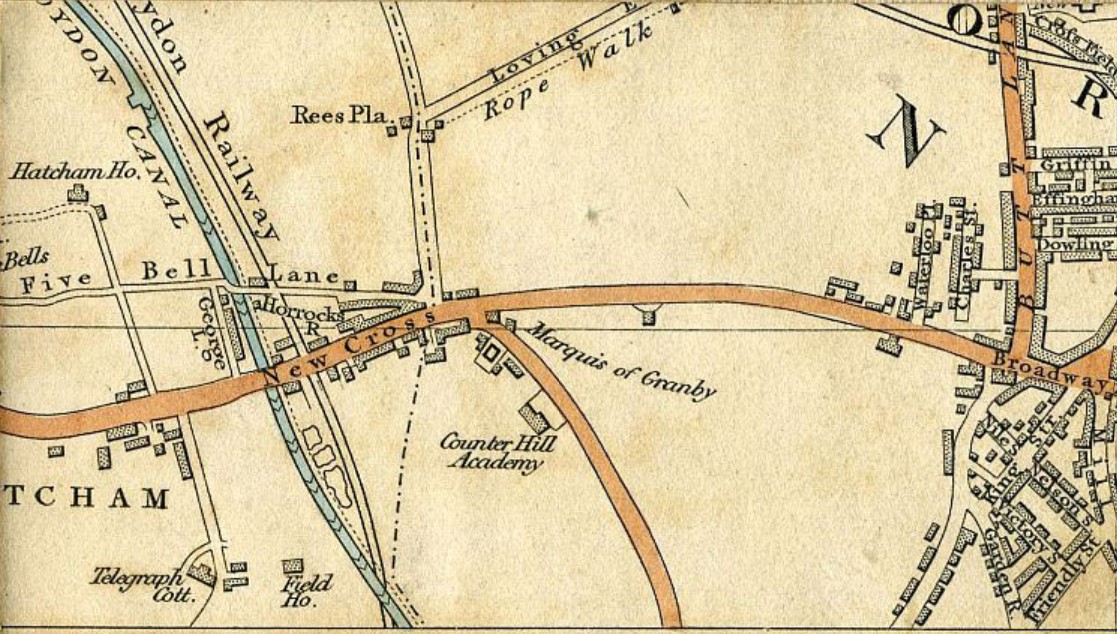
My work is often about rescuing tiny fragments of history from oblivion. Here for example is a rare map of the canal at New Cross. On the bottom left, unfortunately cropped is just visible the name ‘Telegraph Cottage’. (though the words graph tage are only in frame)
That apparently was where Robert Browning had lived for a time.
And now that you have it in the context of Nahum Tate as explained below, you can see why I will add the Chandos pub to the trail.
(The trail is diffuse not linear)
The 1st Duke of Chandos commissioned Handel to write sacred choral anthems, now called Chandos Anthems. Handel needed suitably metred lyrics to set the Psalms to music. And so Handel opted for the Tate and Brady “New Version” of the Psalms (1696) primarily because it transformed prose into poetry, making it far more suitable for the musical structures of the Baroque era.
And it is this emphasis on metre which makes this association with the metre of poetry through Handel and Chandos so divinely apposite.
The Poetry trail sounds great! Perhaps not quite in the same league as the giants you mention, but Spike Milligan too - who lived in Riseldine Road, Honor Oak Park. I’m huge fan of David Jones - a a major poet and artist, now overlooked, who knew many of the great cultural figures in the 20th century and influenced/ was influenced by them. Born in Arabin Raod in Brockley and buried a stone’s throw away in Brockley/Ladywell cemetery.
And I’ve only just realised Gavin was the great nephew of Catford’s Dudley Stamp.
I have Dudley Stamp’s book The Common Lands of England & Wales on standby ready to give context to the enclosure of Sydenham Common.