The time has come to put pen to paper. I will now commence my most ambitious (creative risk-taking) non-fiction writing so far. I must tell the story of something that happened in the lockdowns that has left me so shaken that I may never get over it.
Let’s just call him Brian to lighten the gravity. It sounds Pythonesque.
He was the Lord of the Manor of Lee.
To those of you who might read this who have either indulged me on this or even written on this yourself, I dedicate this to you, you know who you are.
One of the things I learned at Albion Millennium Green is to ask “are we thinking in days, weeks, years, decades, centuries or millennia?”
And that is how we must start this story.
I will now use a magic utterance to summon the spirits, thus:
You will click either the link in the post above and start your adventure there or you are reading this some time in the future when this is only the second post in a very long thread and have decided to keep reading this on the forum before you search.
In the second picture, on the hill of Honor Oak Road is some of the then recently built houses that we presume formed part of a development called by the new appellation ‘Forest Hill’.
It’s the sort of (bucolic) verbal imagery used by developers to sell newly built houses.
But we are above that sort of nonsense, aren’t we?
But not all nonsense is non-sense.
In one of those houses was later a school. And in that school was a pupil. And that pupil later had a son. And that son suggested to Agatha Christie that she call her play The Mousetrap after a subplot in Hamlet.
And on that hill just along at a location known to us as One Tree Hill are the limits of The Honour of Gloucester, a sort of feudal boundary that today we call the border between Southwark and Lewisham.
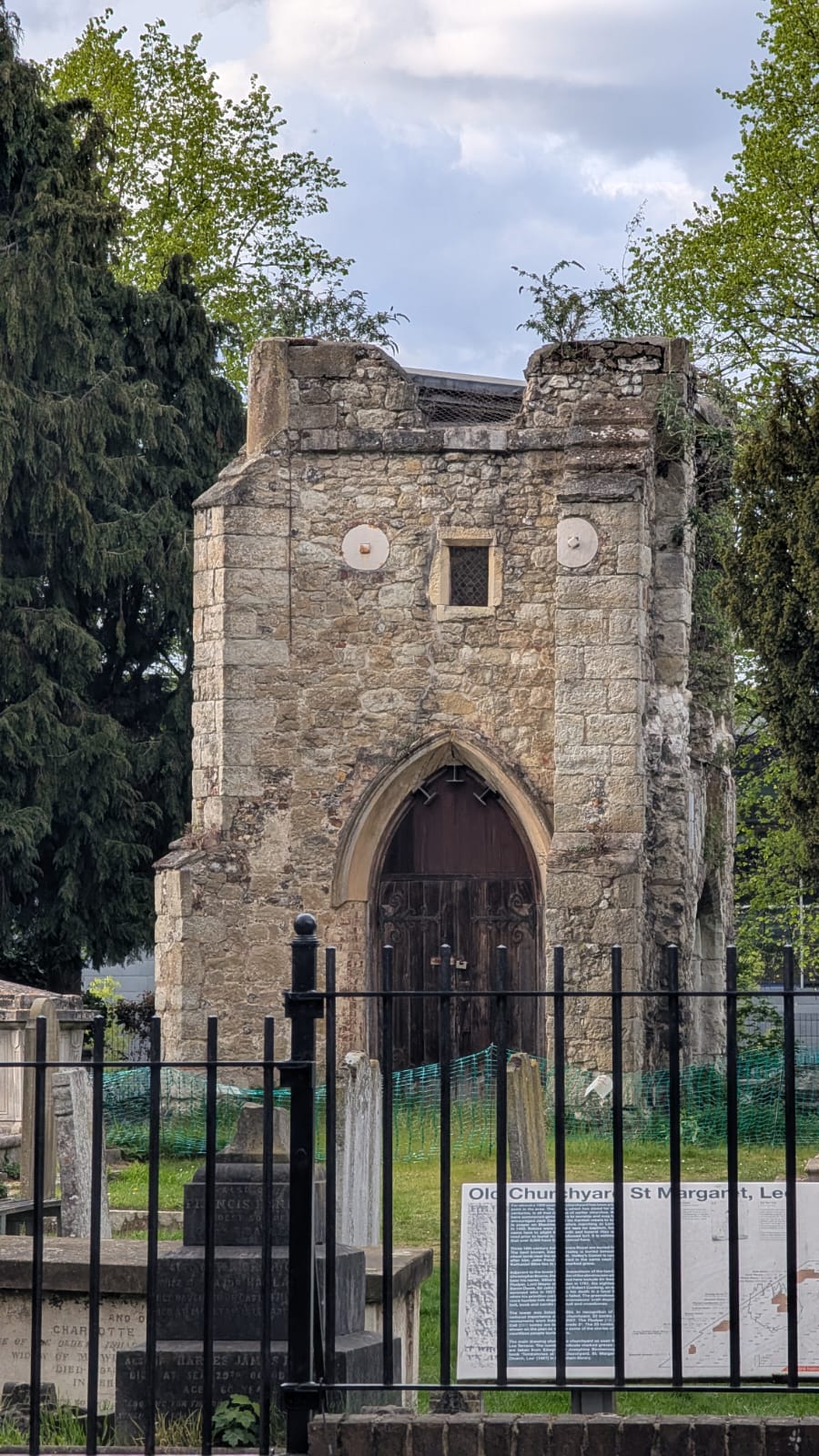
And in a dramatic flash forward, here is the geographical conclusion to the story, a tower in a disused graveyard where Belmont Hill meets Lee Terrace. It’s not that far from Brian’s moated manor house down Lee High Road. I used to pass this tower on a 75 bus on my way to Charlton House a very long time ago.
My school friend Lewis sent me the picture after I began telling him this story.
So why did I write the first few posts in a very unconventional manner?
There is one simple reason, I needed to present some form of chaos, just enough. That way I could relate the unease I experienced as I went through the research process. That way I could frame the fever dream.
I can’t deny I am drawn to artistic experiments, and I would love to indulge my creativity. I love the tension between real life stories and the reality that there is no one single way to tell that story in a definitive manner.
And this story stumped me, because the more I learned the harder it became to tell.
The fact is, I have only assembled known discoveries and then joined the dots. But the effect has been ground shaking and the only way I can hold on is to go through this with you.
Brian Annesley may have had a large portfolio of lands (Forest Place being a farmstead in Brockley, just one of many such ‘holdings’) and lived in a moated manor house in Lee, but worldly riches notwithstanding, as the last years approached he became impaired of mind. He had three daughters and two sons-in-law eager to know what would soon happen to his estate.
I had actually heard of this some time before in the context of Shakespeare studies (minus the locations and details) and so that in itself did not register. Secondly I had also by coincidence been on a walk with Quaggy Waterways Action Group and the blogger Running Past where we saw the approximate site of Brian’s moat by Lee High Road. And once again, nothing spectacular registered in my mind that day as I don’t recall our guides mentioning Shakespeare, after all I’m sure I would have reacted with surprise at the time if they had. I had not the overlapping pieces of information to put the two stories together.
So everything had been set up ready to go off (in my mind at least) if those two facts should collide. And sure enough at the Lewisham Local History Society it was mentioned in a passing comment, that a site most likely opposite The Brockley Jack Pub could have been Forest Place (whatever that meant) and that it could have been connected to King Lear.
Something in my memory was triggered, but the moat in Lee hadn’t been mentioned so I hadn’t sat down and put all the facts together. But I left it for some reason. However on another visit to LLHS the subject was mentioned in passing again and this time I knew I had to get to the bottom of this.
The next thing to happen (chronologically following that last post) was that I led a walk for FHS on the 1st Feb 2020 starting at St.George’s Church. The church was an ideal place to meet in its shadow. The areas we explored were Catford Hill and the Riverview Walk returning to Perry Hill at the site of the defunct Rutland Arms pub. The last topic mentioned was the library on Perry Hill that I think was probably the borough’s first public library. The walk’s theme was (implicitly) the outer edge of Forest Hill.
It wasn’t the first walk I had participated in as a walk leader, but it was the largest group I had led, we had a turnout of 22 adults and 3 children, with 3 last minute apologies from people who really wanted to come. With Alona’s help we were able to stick to our promised 2hr time despite packing in an incredible amount of detail about both history and nature. Thank you again @Alona you know how much we had worked together to make the walk such a success, and it has left me with such a happy memory.
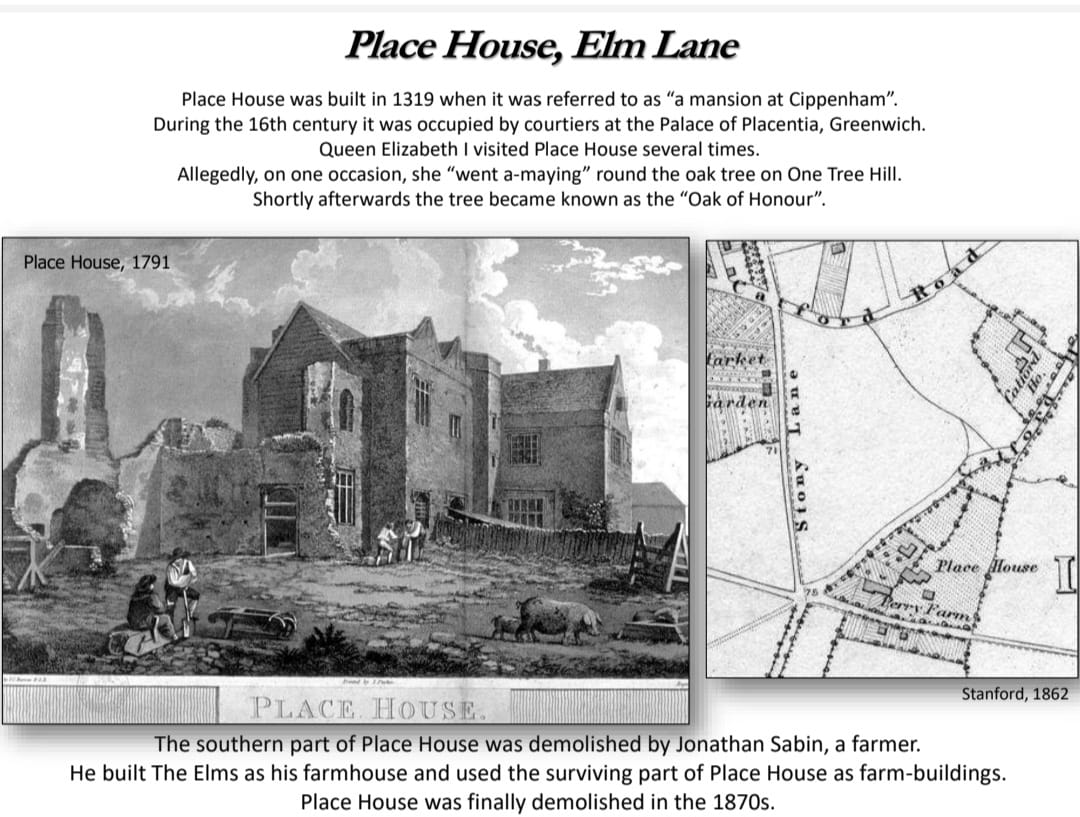
The first location we had examined (on Elm Lane) was the site of Place House also called Sydenham Place. The subject of this location and house is worthy of a pamphlet at the very least. But this slide from Steve Grindlay roughly captures the magnitude of the topic.
And because Place House was by the Roman road from Lewes to Nunhead, it was logical to surmise that Forest Place was likely situated somewhere near St Hildas and The Brockley Jack for that same reason, another Tudor or earlier ‘manor house’ (I use that term loosely since that has become a catch-all term) by an early route. Even though the so-called Roman road was dilapidated as a structure, destroyed/invisible even, its route through fields across South London shaped the locations of several intersections I would presume.
Forest Place would therefore have been at an intersection of one major route between Deptford and Croydon, and another ancient route between Lewes and Nunhead where it then joined the Roman route from Canterbury to London (as used by Chaucer’s Pilgrims). This is no more significant than other locations which developed for similar reasons.
But what did spring to mind was the question that as Richard Bulkeley of Place House and Brian Annesley of Lee (who owned Forest Place) were contemporary, did they know each other? And that’s where I started to think hard about where to look next.
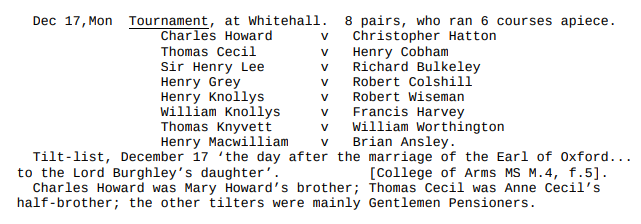
And sure enough here they are in a jousting tournament on Dec 17, 1571. The source is authoritive as it comes from the Folger Library which has one of the finest archives on Shakespearean documents in the world. Note that Brian Ansley is the spelling used here.
So, I haven’t mentioned King Lear properly yet. If you didn’t google at the beginning it’s possible you got this far and didn’t even know this is all about King Lear. (and yet so much more!!!)
I know it sounds outrageous, that’s why it has taken me about 6 years to look into this first before I considered what I would do.
In synopsis, Brian Annesley as you have now seen from the 1571 tournament was once within an elite circle of courtiers close to Elizabeth I, in fact an actual bodyguard, both real and ceremonial, his loyal service was rewarded with several further honours as was typical in the Tudor system of patronage. So when he became mentally frail late in life and his 3 daughters started to fret about falling out over his estate, it didn’t take long before everyone in Elizabeth’s inner court knew about the situation.
The daughter that in retrospect is now portrayed archetypally as the ‘good’ one was called Cordell. She was named in honour of William Cordell who had overseen the estate of Mary I, not as an executor but as a high ranking judge. Crucially Elizabeth retained his services as Master of the Rolls which is a fact that has been overlooked in the importance of this story given this theme is about dynastic transitions.
And so Shakespeare we shall conjecture re-wrote King Leir (an earlier anonymous play) as King Lear to capitalise on the currency of the situation. The name Cordell does remind us of Cordelia and her two ‘wicked’ sisters.
Of course when this all became clear in my mind I was so shell shocked that Lewisham was actually connected to Shakespeare, and Forest Place specifically being part of Brian’s will that I had a life changing moment. I decided to REALLY REALLY look deep into this.
Every so often I might pause the telling of this story to reflect. My thoughts now are dwelt on the phrase spoken by King Lear: “Nothing will come of nothing”.
It is spoken in anger to his daughter Cordelia because she has refused to be sycophantic like her two sisters.
If I have understood it correctly this is a portent from Lear unaware that he is forecasting his own demise. As a piece of theatre, the playwright is warning us that we are about to see a tragedy unfold.
But undeniably the universal truth expressed here is that Lear wished to feel loved or wanted, yet tragically he was unable to see Cordelia did love him.
The play was later rewritten with a happy ending by Nahum Tate.
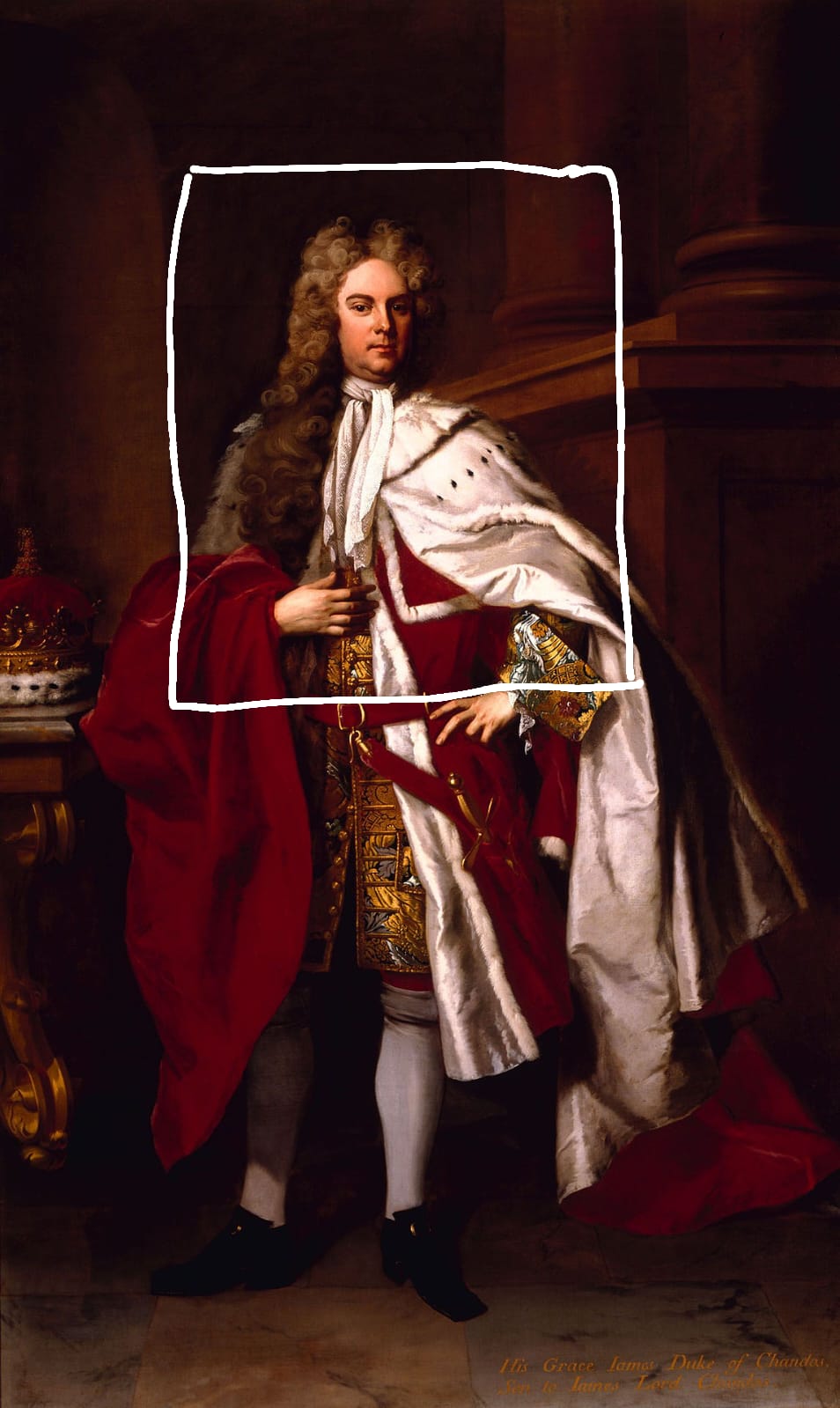
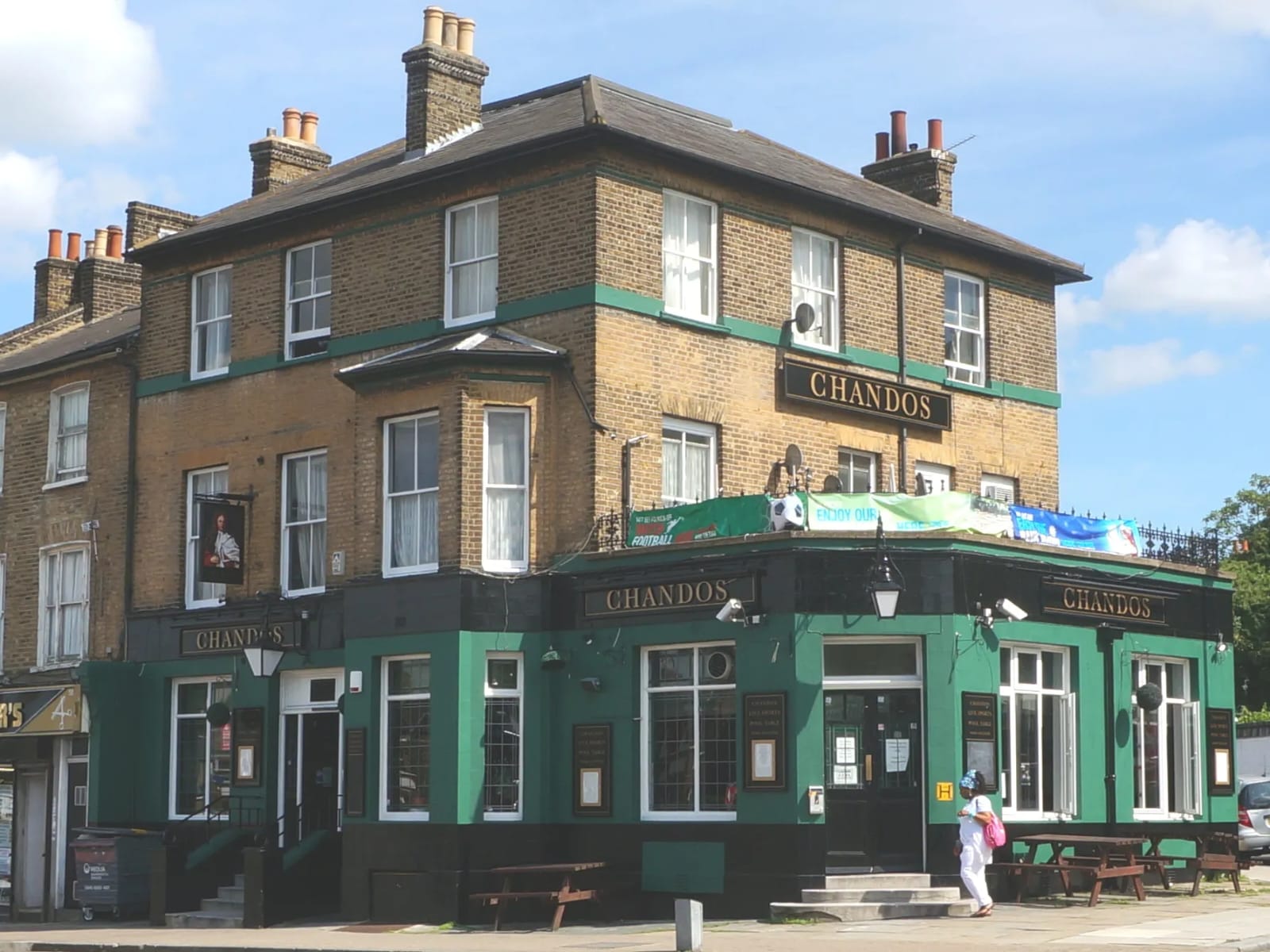
When I discovered Nahum Tate had rewritten the play with this happy ending and that Tate had also unwittingly influenced Handel’s work for James Brydges, 1st Duke of Chandos that the Chandos pub is named for (as per its original pub sign picturing that very Duke) I was gradually drawn into this mystery.
The Chandos pub sign, after decades of seeing this on the way to school, unaware that it was James Brydges it is now one entrypoint into a psychogeographic investigation. And this man is circuitously part of the epic backstory behind the legendary Chandos Portrait of Shakespeare. I was Shaken.
Heavens above, we have been blessed yet again with another fabulous tiny detail that is pure psychogeography. It is possible that an early landlord at The Brockley Jack was actually called Jack.
In my quest to evaluate how or why it is credible that the real-life story of Brian Annesley influenced (in any way) the writing of King Lear I have of course had to study King Lear inside out, and anyone or anything connected with it or the contemporary scene within Elizabeth’s Court, James’s Court, the playwrights, the politics, etc etc.
It can get very heavy and I will take breaks lasting months before returning back to this specific area of study. In the intervening period tiny details pop up which some might call synchronicity. They may not be causally related, even though some are tenuously connected such as three individuals in a family tree who give their name to The Chandos Portrait of Shakespeare or NPG1, the first accessioned picture of The National Portrait Gallery. I will expand on this properly later.
In King Lear there is a reference to the junior knight Childe Rowland thus:
Child Roland to the dark tower came, His word was still Fie, foh, and fum, I smell the blood of a British man. Actually a line spoken by a man (Edgar) feigning madness.
This line from Shakespeare would presumably go on to influence the wording used in writing Jack and the Beanstalk.
I was intrigued that Robert Browning had (much later) then also written the poem Childe Roland to the Dark Tower Came, intrigued because he had lived so relatively near at New Cross. I was then stunned that Stephen King had picked up on this very early in his writing career and in an interview explained how influential this poem from Browning had been on his imagination.
So there I was, quite happily buying books about King Lear and Shakespeare and making notes, listening to hundreds of hours of youtubes and podcasts. And I was looking at the marriages of these three daughters of Brian. It stood out immediately that Christian Annesley had married William Sandys, 3rd Baron Sandys. The reason being that I knew the name Sandys from two other places, Richard Bulkeley of Place House whose two daughters had married two Sandys. And the Sandys family at The Vyne Hampshire, where much later a mysterious cursed ring would turn up, and is on display, connected would you believe to Tolkien. And it was at The Vyne in Hampshire that Christian and William would live when away from London court life. (Queen Elizabeth visited The Vyne)
And when I researched that Tolkien part I found a woman called Lynn Forest-Hill.
I thought this is ridiculous. This was the start of the fever dream. To compound matters, a circle later connected to The Vyne and the Walpole family was involved in the destiny of The Chandos Portrait of Shakespeare through the way marriages were arranged. By complete coincidence William Sandys first wife Katherine Brydges was from the same family who much later came into the possession of the Chandos portrait.
I actually thought I was losing my mind, and this whole process hasn’t eased up and I have barely introduced you to the mysteries.
When I started to write this I had not properly planned out a logical sequence in which I would reveal the information. I took it for granted that this was an experimental form of writing, which I have come to embrace. I was obviously very hesitant at the start because of the confused way I grasped at the opportunity to invoke the Pythonesque (re:Brian) which was clearly because I was so nervous, like when you chat in the pub and try to make a joke, which at the least shows (some) willing to the listener you are open to humour.
I don’t regret this because it really illustrates the complex situation we are in as a pool of knowledge brokers exchanging information in such an asymmetrical way, this being a specific interest in my research as a futurologist concerned with the dissemination of ideas.
As I am yet to provide the basic (or starting) type of references that I myself would expect if I was to correspond with someone about a theory, I have only this morning while going over my notes about the dating of King Lear checked my purchase history to see that I had ordered on 30 May 2020, Katherine Duncan-Jones book Shakespeare: An Ungentle Life (Arden Shakespeare): Amazon.co.uk: Duncan-Jones, Katherine: 9781408125083: Books and it is there that around that date my first serious intention to persue the link to Brian Annesley first became apparent. It is from that book that the basic explanation was simply expressed so that I could confirm in my mind there was enough to warrant a serious investigation. I would not of course know what the outcome could be or what would happen next.
My point being that even when we have access to the same sum total of information, the order in which we encounter each piece has a dramatic outcome on the way we perceive or construe what we believe to be true about it.
And I am now in the position that since starting this topic I have continued to develop this research apace. I must be mindful to relate the story of my analysis in the order in which I discovered the information because this is a testimony of how the sense-making process happens.
Yesterday I went to Nunhead Cemetery Open Day and got to speak again with members of Lewisham Local History Society. As I had hoped they had the no.26 2018 issue of Lewisham History Journal available for sale which I bought. That issue contains the article by Carol Harris ‘From Brockley Green to Crofton Park’ based on a talk she gave LLHS in January 2017.
A short extract from that article was published on her blog and I thank her for bringing this story (about Brian/Bryan Annesley) to light in the context of Forest Place, even if we still cannot determine exactly the definitive precise location or shape/nature of the building. Carol has incentivised us to think about the significance of the story and investigate further.
It’s worth noting at this point that it may have crossed your minds by now that discerning the probability whether Brian Annesley has anything whatsoever to do with King Lear could be an intractable problem. We might be able to address this using an epistemological framework sometime later which deals with these types of problems, but I am still swatting up on that in a separate research strand, one that will eventually contribute I hope also to animating discussions about how as citizens we use and misuse evidence when formulating the argumentation to invite or initiate interventions in the public sphere.
In the meantime I wanted to reflect on an example of a scholar who has devoted her life to meticulously gathering the evidence base for everyday life at court in Elizabeth’s reign. It is from this actual tranche of scholarship that we can be confident for instance that Brian Annesley and Richard Bulkeley were in situations at court life that they would have been aware of each other (as was quoted earlier). Later I will determine how closely their respective sons-in-law (the Sandys family) were related as part of an extensive kinship network analysis which I been working on and off now for several years!!!